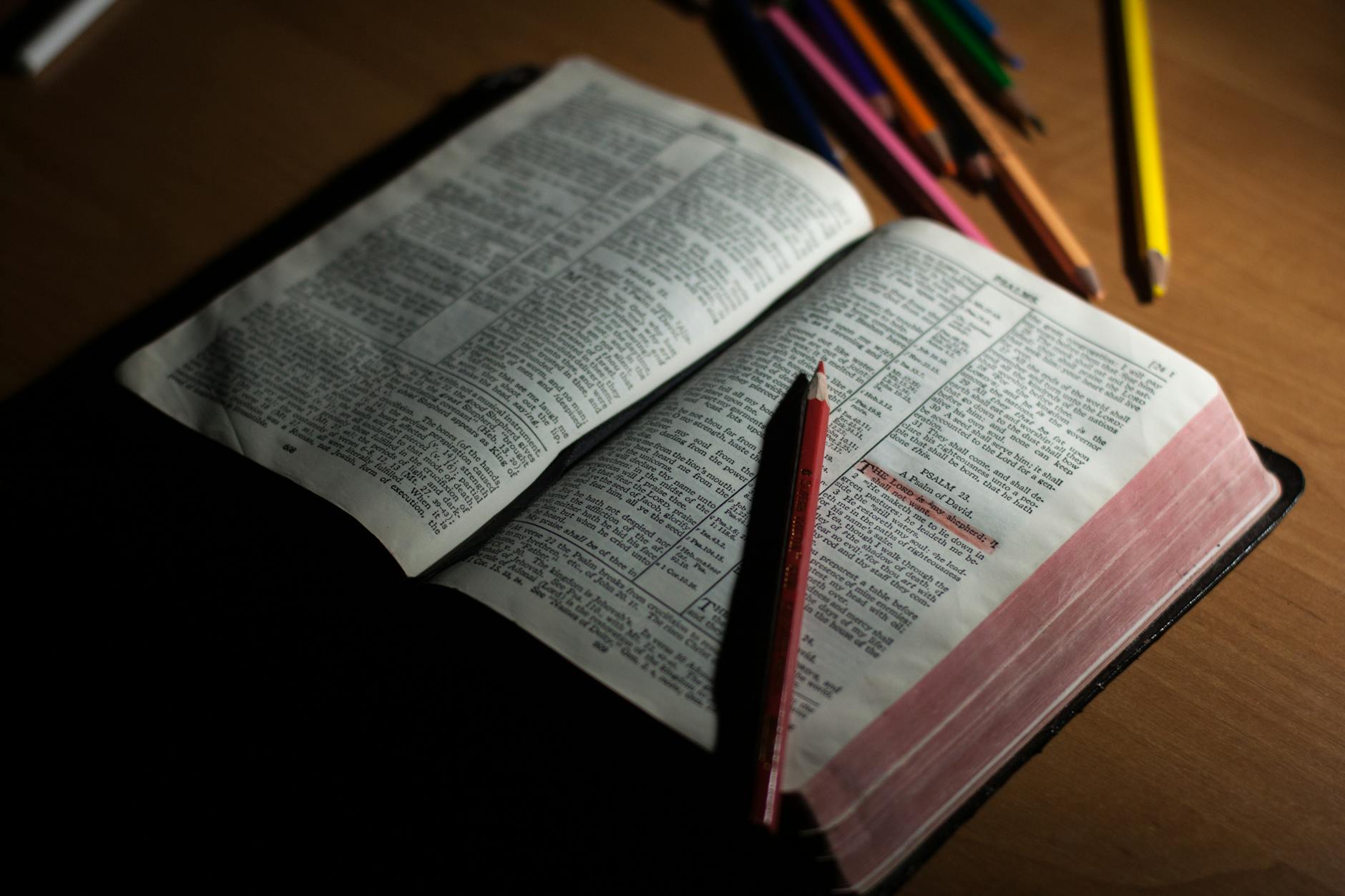
Read your Bible.
Pray every day, Pray every day, Pray every day.
Read your Bible.
Pray every day.
And you’ll grow, grow, grow.
And you’ll grow, grow, grow.
And you’ll grow, grow, grow.
Read your Bible.
Pray every day.
And you’ll grow, grow, grow.
Don’t read your Bible.
Forget to pray, Forget to pray, Forget to pray.
Don’t read your Bible.
Forget to pray.
And you’ll shrink, shrink, shrink.
And you’ll shrink, shrink, shrink.
And you’ll shrink, shrink, shrink.
Don’t read your Bible.
Forget to pray.
And you’ll shrink, shrink, shrink.
As I’ve grown older, I’ve found that I revel in routine and predictability—two words that my 20-year-old self would have shuddered to hear. Most mornings I wake at around 5:30 and blearily wait for the coffee to finish brewing. Once I have my cup filled, I sit down in my recliner and open my Bible. My brain is still a bit foggy, but I read a few chapters and do my best to be drawn in and meditate on the truth of what I’m reading. Then I pray for direction and wisdom for the day for myself and my family, forgiveness for my sins, and for the Lord to help others who are sick, struggling, or need wisdom. Twenty to thirty minutes after I’ve started, I’m done, and I move on with the rest of my day.
My personal worship time has changed quite a bit since I became a Christian over twenty years ago. The sporadic and unfulfilling Bible reading and prayer in my teens slowly changed and improved until they became an integral and enjoyable part of my daily life. Do I do it perfectly now? No! I sometimes can’t tell you an hour later what I read that morning, or I give in to the day’s busyness and don’t take time to pray. But almost every day, I wake up early and come before the Lord to open myself to Him. My daily rhythm of Bible reading and prayer took years to develop, and I’m not done growing.
A regular devotional time has become one of the most common indicators of the spiritual health of a person in our communities. When we are children, we sing songs telling us that how often we read the Bible or pray is directly related to our spiritual strength. As adults, we’re encouraged to have a daily devotional time. When I’m asked how I’m doing in my walk with the Lord, or when I ask others the same question, we typically mention how we are doing in our devotional life.
“I have to admit that I’ve struggled to find time to read in the mornings over the last few months.”
“I’m doing well in my Bible reading, but my prayer life has been struggling.”
“Praise the Lord! Lately, I’ve been doing much better at being in the Word and in prayer every day.”
Aspiring to build a regular devotional life is a good thing, but we can easily fall into the trap of thinking that good devotional life = good spiritual walk. Without realizing it, we may begin subconsciously believing that if we simply read the Bible and pray regularly enough that we will be in good standing with God. That if we take our spiritual vitamins every day like the preacher told us to, spiritual vitality will automatically come. We would never say out loud that reading your Bible makes you righteous, but even so, do we start assessing the spiritual health of ourselves and others simply by how well we are holding to a habit?
What is the reason for this way of thinking? Maybe it’s because people’s devotional lives are the simplest and most visible insight we have to the condition of their hearts. I can’t get into my brother’s head and see what his thought patterns are, so the frequency of his devotions is a useful stand-in to determine his spiritual health. It could also be that we don’t possess the vocabulary or self-knowledge to express what is going on inside of us. Or maybe we are just uncomfortable being vulnerable and baring the raw condition of our souls to others. Whatever the reason is, the way we do or don’t talk about our spiritual condition can begin changing what we believe constitutes a close walk with the Lord.
“Two men went up to the temple to pray, one a Pharisee and the other a tax collector. The Pharisee stood and prayed thus with himself, ‘God, I thank You that I am not like other men—extortioners, unjust, adulterers, or even as this tax collector. I fast twice a week; I give tithes of all that I possess.’ And the tax collector, standing afar off, would not so much as raise his eyes to heaven, but beat his breast, saying, ‘God, be merciful to me a sinner!’ I tell you, this man went down to his house justified rather than the other; for everyone who exalts himself will be humbled, and he who humbles himself will be exalted.”
(Luke 18:10–14 NKJV)
In this parable, Jesus is using two vastly different characters, a Pharisee and a tax collector to teach a lesson on what makes someone justified (declared righteous) in the eyes of God. The first thing we notice about the Pharisee is that he compares himself to others: “God, thank you for blessing me so that I’m not an unrighteous and evil person like this tax collector over here.” Next, he tells God about all the good things he does regularly: “I discipline myself to not eat twice a week, which is more than you even require, and I give liberally to the temple.” The tax collector has much less to say: “God, I know that I am a sinful man. I beg of you, be merciful to me!”
In a conclusion that likely scandalized his audience, Jesus tells them that the tax collector was the one who was declared as righteous, rather than the Pharisee. The listeners certainly expected that the Pharisee was the righteous one—just look at all the good things he does and the fact of who he is and his position in society! But no, those who are humble will be exalted, and those who are proud will be humbled.
The verse that comes right before Jesus begins speaking is the key to understanding the purpose of the parable. “Also He spoke this parable to some who trusted in themselves that they were righteous, and despised others:” (Luke 18:9). The Pharisee was an example of the type of religious person who trusts in his own righteousness and ability to do good works. This inevitably leads to comparing himself to others and considering himself superior to those who don’t measure up to his standard of what is righteous (2 Cor 10:12). He says pious things and thanks God for how righteous he is, but he actually is trusting in his own righteousness, his self-righteousness.
It’s all too easy to fall into a version of Christianity where I turn the Christian walk into a checklist similarly to the Pharisee listing all the good things he does.
Bible reading, CHECK.
Prayer, CHECK.
Tithing, CHECK.
Memorizing Scripture, CHECK.
Fasting, CHECK.
I can start thinking that if I check those things off every day, week, or month, then God smiles down upon me. From this perspective, it’s a short hop to comparing myself to others. If I’m better at completing my checklist every day, that must somehow rank me above my brother or sister, and certainly above those from outside our church! Just like the Pharisee, this sort of self-righteousness is based solely on the works that I am doing when I compare myself to others.
The tax collector has the completely opposite posture before God. In humility and sorrow for his sinful condition, he cries out to God and asks for mercy. There is no looking over to the Pharisee and feeling inferior, or to a Roman soldier and feeling superior. He looks to God, sees his sinfulness in comparison to God’s righteousness, and can’t even raise his eyes to heaven.
In the tax collector’s reaction, we see the best solution to checklist Christianity—a proper perspective of ourselves and our righteousness before God. Paul said that the best he could do was no better than garbage and that he didn’t want a righteousness that comes from following rules, but righteousness from God that comes through faith in Christ (Phil 4:3-9). Instead of looking at others and comparing ourselves and our self-righteousness to them, we should look to Christ and his righteousness. When we see his perfection, whatever self-made “righteousness” we may have will look like filthy rags.
We should also see our devotional life for what it is, a means to an end, not the end itself. We read the Bible so we can be changed and transformed by the Scriptures and the Spirit working in us. We pray to communicate with God and allow him to speak to us. If we are not allowing the Spirit to transform us into the image of Christ and we are not truly communicating with God, then all our reading and praying is of little use.
The Pharisee undoubtedly read the Hebrew Scriptures more than the tax collector, and he likely prayed more often. But even so, it’s clear that all the religious practices he had done had not affected his heart. His words showed he was proud of the good works he did, and that pride is what undid him.
Developing good habits of Bible reading and prayer are vital for a Christian, but we must resist the temptation to let our own righteousness take the place of a proper view of our need for Jesus and his righteousness in us. If you, like me, find that your devotional life is sometimes closer to a checklist than a living and growing relationship with Jesus, fall to your knees and cry out, “God, be merciful to me a sinner!”
 Invisible Things
Leave a comment