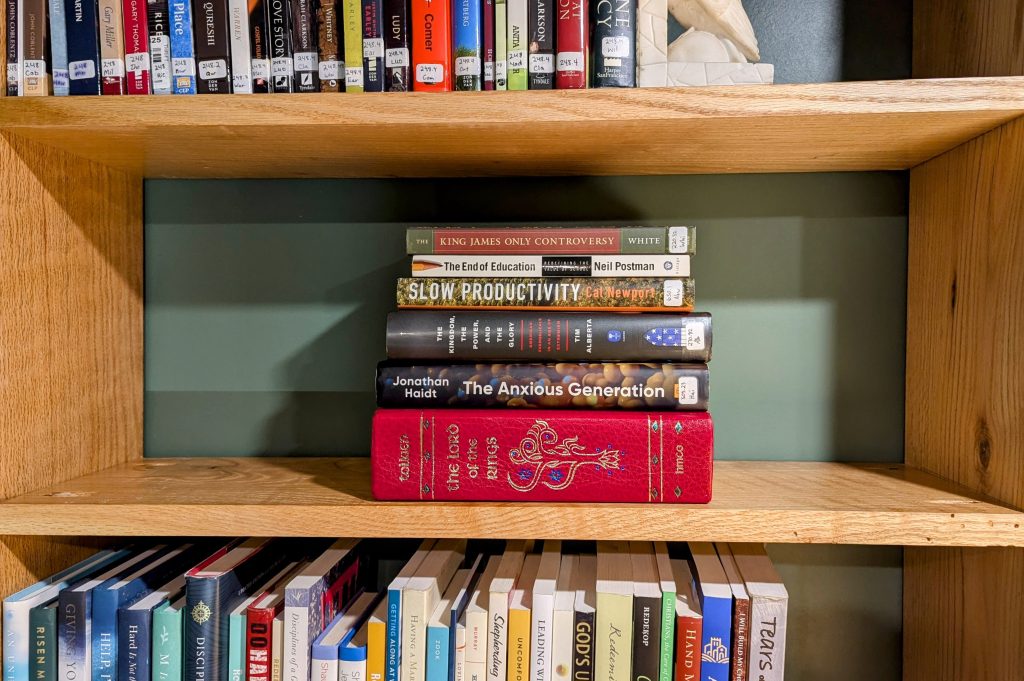
At the end of every year, I always enjoy reading the “Best Books I read in …” articles or watching tech YouTubers talk about the best phone or laptop of the year. Since I’ve always been a consumer of such posts, I decided that maybe 2024 should be the year in which I chuck whatever I have into the maelstrom of posts and videos that are posted in the few weeks following Christmas and into the New Year.
Looking over my Goodreads for the year, it was even more clear than ever that I don’t read much fiction. For that reason, I decided to lump my fiction and nonfiction books together. Not to mention, most of the fiction I read is not really of literary quality, so that winnowed even more fiction out of the running. Perhaps one of my 2025 reading goals should be to read more literary fiction. Please let me know if you have any recommendations.
Here are my favorite books in reverse chronological order and roughly ranked. It’s interesting that it seems that as the year progressed I seemed to enjoy the books more. Or maybe it’s just because I remember more of the ones I read more recently. I guess we will never know.
1. The End of Education: Redefining the Value of School—Neil Postman
I saw this book in a used book store and picked it up solely because I’ve read some of Postman’s technological and social criticism in his books Amusing Ourselves to Death and Technopoly A side note: I highly recommend these books, even though they are now a bit dated. Postman does a remarkable job producing writing that is relevant decades after it is published. I wish I knew how he did it.
From the first page of the Introduction, I was blown away. I think that probably 50-70% of the pages in this book were marked or annotated in some way by the time I reached the last page. I tend to mark nonfiction books, but this book was on another level.
This is the sort of writing that I wish I could do. Compelling, incisive, and beautiful. It reads a bit like a polemic, and it probably could even be classified as one, but wow, what an insightful book. As someone who has worked much of my adult life in education, I wish I had read this book in my early 20s. Or maybe I wish I hadn’t. I’m afraid that my younger self would have likely used this book to bludgeon others with idea after idea that challenged the status quo of how school is currently done.
When I read some books, I feel like a boy splashing his feet in a cool brook—the book refreshes me, but I don’t end up remembering much from it. This book was not like that. I felt more like a tree that soaked up every drop of moisture I could. Out of all the books that I read this year, I wonder if this one might stick with me longer than all the rest.
I’ll leave you with one of many pithy quotes from the book:
For school to make sense, the young, their parents, and their teachers must have a god (a transcendent purpose) to serve, or, even better, several gods. If they have none, school is pointless. Nietzsche’s famous aphorism is relevant here: “He who has a why to live can bear with any how.” This applies to learning as much as to living.
To put it simply, there is no surer way to bring an end to education than for it to have no end [purpose and goal].
2. The Anxious Generation: How the Great Rewiring of Childhood is Causing an Epidemic of Mental Illness—Jonathan Haidt
I first encountered Jonathan Haidt’s work in a book he wrote with a coauthor called The Coddling of the American Mind: How Good Intentions and Bad Ideas Are Setting Up a Generation for Failure. I enjoyed it and thought it was insightful, but didn’t seek out any more of his books. Then I heard Cal Newport mention on his podcast that he had recently read an essay in The Atlantic that he enjoyed called “Why the Past 10 Years of American Life Have Been Uniquely Stupid.” It was a fascinating essay that prompted me to subscribe to his Substack. I followed his posts over the next year or so, reading many of them which focused on the negative effects of social media on young people. I had already signed out of most of my social media accounts before I started following Haidt’s work, but reading his findings further solidified my belief that social media is a waste of time at best, and at worst, genuinely destructive to mental health and relationships.
When I noticed he was coming out with a book that summarized much of what he had written on his Substack, I pre-ordered it on Amazon and dove into it as soon as it arrived at my doorstep. His point was made in the first quarter of the book, but he didn’t let up until it seemed clear to me that social media is a force that somehow slid into our lives without us realizing its effects. Ten or so years ago, we didn’t know what we were putting onto our phones and letting into our homes, but now we do.
It wasn’t all gloom and doom, though. He ended the book with some concrete recommendations. One of them is simply to not allow children to have smartphones until they are in their teens, and to keep them off social media until they are sixteen. I would probably go even further than Haidt did on this point, but I think where he came out would still be considered extreme by many people today.
It will be interesting to see what the eventual impact of Haidt’s book will be in another decade, but I predict that it will be the crest of the first wave of changes coming to tech and government. Just in the last few months, some officials in Australia are trying to pass a law that would make it illegal for teens to be on social media until they are sixteen. Perhaps this effort is independent of Haidt’s work, but I would find that difficult to believe due to the age they specify and the timing of the law.
I believe there is cause for optimism in this area that has been mostly pessimistic over the past ten years. With some parents, and even teens, more clearly aware of the problem, there is a better chance that a groundswell can build that will result in a shift away from spending our lives connected to the Internet. I just hope that Anabaptists will be at the head of this shift, not lagging a decade behind as we often seem to be.
3. The Kingdom, the Power, and the Glory: American Evangelicals in an Age of Extremism—Tim Alberta
If you’re at all like me, you might have wondered how Donald Trump, a twice-divorced philanderer, has managed to put many evangelical Christians, and even some Anabaptists, into his thrall. Within my memory, Republicans and conservative Christians lambasted Bill Clinton for his affairs while he was President. In the late 90s, Christians said, and I believe rightly so, that the moral character of a leader is important, even in a personal area like who he decides to sleep with. But now it seems we’ve decided that moral character isn’t as essential as it used to be in the leaders we support.
Since the first election of Donald Trump, the landscape of evangelical Christianity has fundamentally changed. Why is that? What drove the same people who castigated Clinton into the arms of Trump? How has the more politically charged culture affected churches? Has Trump and the politics of Christian nationalism moved us toward the kingdom of heaven, or away from it?
Alberta states that our current moment in American Christendom is the manifestation of a movement that began decades ago. He reflects back to the 1980s when evangelical Christians began allying themselves with the political right to form Jerry Falwell’s Moral Majority. In many ways, their goals were noble, to reinforce and defend Christian values, but this was done using the power of the state. They likely couldn’t have predicted how this would eventually impact the souls of their church members as well as their own.
A few lines from inside the dust jacket explain it well;
Accessing the highest echelons of the American evangelical movement, Alberta investigates the ways in which conservative Christians have pursued, exercised, and often abused power in the name of securing this earthly kingdom. He highlights the battles evangelicals are fighting—and the weapons of their warfare—to demonstrate the disconnect from scripture: Contra the dictates of the New Testament, today’s believers are struggling mightily against flesh and blood, and with eyes fixed on the here and now, desperate for a power that is frivolous and fleeting.
The Anabaptist church has been somewhat insulated from the convulsions that the evangelical world is going through. This is due to our historic belief in separate earthly and heavenly kingdoms, but that is beginning to weaken, and we are starting to give in to the siren call of political power and influence. How long will we maintain our separation from politics and the earthly kingdom?
If you feel like the church is America has lost its way, and you wonder how that happened, this book will go a long way toward helping answer your questions.
4. Slow Productivity: The Lost Art of Accomplishment Without Burnout—Cal Newport
This is the latest entry in Newport’s corpus of productivity books. I started down the path of becoming a Newportian acolyte when I read his Deep Work about six or seven years ago, and then the draw toward the Deep Side became stronger when I read Digital Minimalism and A World Without Email. Now I pre-order his books six to nine months before they are available and read them almost as soon as my trembling fingers can tear open the Amazon box.
Over the past ten years I married my wife and now have three energetic boys, I’ve been given leadership responsibility at work, I am more involved in church life, and I started some creative side projects (this blog being only one of them). Now I find that the demands on my time and the projects, both work and personal, that I’d like to work on far outstrip my available time and energy. When I put resources into anything, something else has to suffer. For example, I’m typing this in my study on New Year’s Day morning while my family is upstairs. This reality has made it ever more important to me to make sure that I’m using my time to the fullest, and that I’m using it in the right way.
As a finite and limited human with a nearly infinite number of projects and goals that I’d like to accomplish, and with many demands on my time and attention, it is easy to become overwhelmed and frantic. Slow Productivity gave me permission to take a deep breath and slow down instead of constantly having my foot on the accelerator.
Newport outlines three main strategies to achieve more while not falling prey to burnout and cynicism.
- Do Fewer Things
- Work at a Natural Pace
- Obsess Over Quality
One of the key ideas that came out of this book that I find myself referring to regularly is the idea of an overhead tax. Newport posits that every project has a certain amount of overhead, be it communication with others involved in the project, small tasks you have to do to keep things moving, or even the space it takes up in your brain to make sure you don’t let something slip. He believes that as you take on more and more projects, that the amount of overhead tax keeps accruing for each project. Even if you are only working on two of your ten projects at any one time, the overhead tax from the other eight keep crowding out time you could be spending on the two active projects, which decreases your effectiveness and increases mental strain.
If you feel like you’ve been teetering on the edge of burnout for weeks, months, or even years, Slow Productivity is a great book to help you reset and rethink your relationship with work and productivity.
5. Island of the World—Michael O’Brien
This book takes you on parallel journeys through geography, humanity, and the human soul. You begin in the 1940s during World War II in what was then Yugoslavia. You follow the main character through tragedy after personal tragedy. He rejects the God who allowed these things to happen, but he slowly returns to faith as he realizes that the God he has rejected has not let him go. This sort of story arc is often written in a sentimental or formulaic way, but O’Brien manages to write a book that makes the ending feel like it was bought with blood.
Not sure what else to say, except that you should read this book.
Honorable Mentions
1. The Lord of the Rings—J.R.R. Tolkien
This past winter, I finished my either 9th or 10th read through Tolkien’s masterpiece of imaginative literature. For a few years in my late teens and early 20s, I read LOTR once a year. My single-minded obsession has faded, but the truth I encountered within the pages has not. This time through I enjoyed it differently than the first time I read it, but I still found my heart beating faster as Sam and Frodo neared the end of their journey.
This book didn’t make it onto my top five for the year since it’s not a new book to me, but this would be one of the three books I would take if I was stranded on a desert island. (The other book would be the Bible, not quite sure what the third one would be. Maybe To Kill a Mockingbird by Harper Lee?)
Here is the passage that has stuck with me the longest.
“There, peeping among the cloud-wrack above a dark tor high up in the mountains, Sam saw a white star twinkle for a while. The beauty of it smote his heart, as he looked up out of the forsaken land, and hope returned to him. For like a shaft, clear and cold, the thought pierced him that in the end the Shadow was only a small and passing thing: there was light and high beauty for ever beyond its reach.”
2. The King James Only Controversy: Can You Trust Modern Translations?—James R. White
Some of my reading this past year was in preparation for a Looking Over Life episode about Bible translations that we have yet to record. Granted, I haven’t read many books on this topic, but this book seemed to do a good job listing the reasons why people believe that the King James Version is the only accurate English Bible translation. It also explains why many of those reasons don’t hold up under strong scrutiny. This is a good book to read if you have any interest in the discussion around Bible translations and the controversy surrounding them. The author stands pretty clearly on one side of the debate, and he makes no apologies for it, but he seems to treat the other side charitably, which I appreciated.
3. Extreme Ownership: How U.S. Navy SEALs Lead and Win—Jocko Willink
I had heard about this book years ago, but never took the time to read it. A friend recommended it to me and lent me her copy, and I was glad that she did. This book reached the five-star level from me due to its unflinching look at leadership and how leaders must take responsibility and own all aspects of the people and things they are responsible to lead. Much of the book uses examples of leadership from the military, but many of the principles would work well even in business and family leadership. I’ve heard that Willik’s book The Dichotomy of Leadership is even better, which puts it on my to-read list for 2025.
Plans for 2025
I normally don’t plan out what books I will read each year. Instead, I more follow Alan Jacob’s direction to “read at whim.” This year I have some reading and research to do related to a writing project, but apart from that, I’m probably going to read more church history and theology. If you have suggestions in either of those areas, please let me know!
Have a blessed 2025.
 Invisible Things
Leave a comment