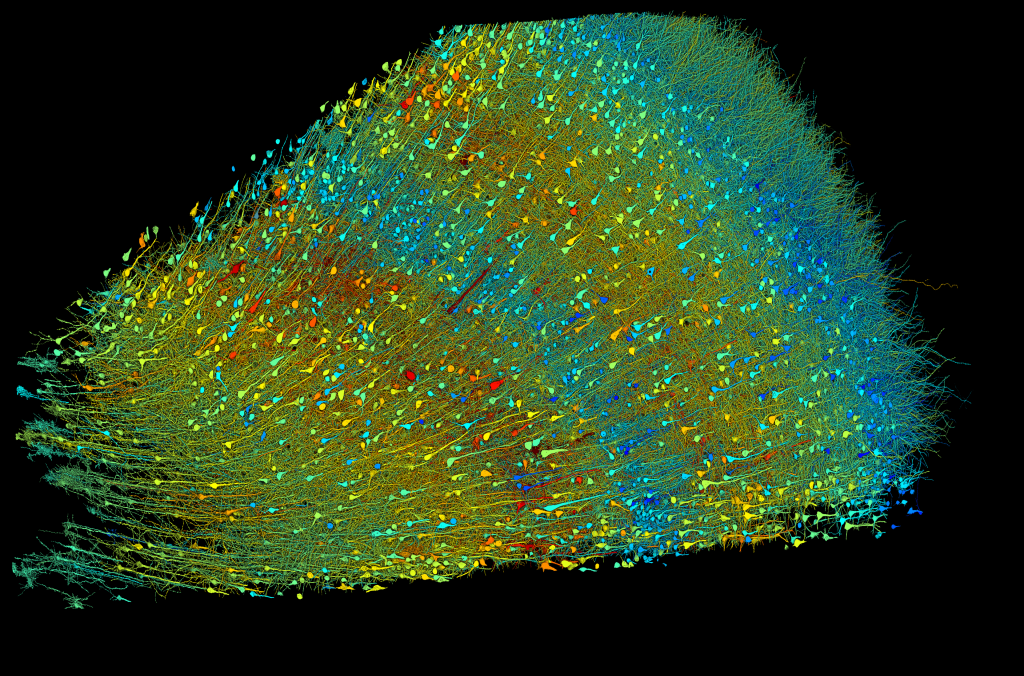
In early May 2024, a group of scientists published a paper in the scientific journal Nature. In it, they described their work mapping a chunk of a human brain. The piece of brain, about half the size of a grain of rice, had been removed from a 45-year-old woman who underwent surgery to help treat her epilepsy. Neuroscientists from Harvard then took the tiny sample of brain tissue and cut it into around 5,000 slices, each one about 1,000 times thinner than the width of a human hair.1
Once they prepared the slices, they imaged them using an electron microscope, then used AI models to stitch the images together to reconstruct the sample in 3D. Viren Jain, one of the co-authors of the paper, reflected on first viewing the 3D model of the brain sample: “I remember this moment, going into the map and looking at one individual synapse from this woman’s brain, and then zooming out into these other millions of pixels. It felt sort of spiritual.”2
The final image of the tiny piece of brain tissue that contained 57,000 cells, 230 millimeters of blood vessels, and 150 million synapses resulted in 1.4 million gigabytes of information. What the team found was unexpected. There were some neurons that had more than 50 connections with other neurons. This could be the result of learning that strengthens certain pathways in the brain. There were also places where the neurons were wrapped into knots. They had never seen this and aren’t sure at this time what the purpose of this might be. Viren Jain stated: “It’s a little bit humbling. “How are we ever going to really come to terms with all this complexity?”3
There have been vast strides in the last few decades in learning more about the human body. One clear example of this is mapping the entire human genome and making genetic testing routine and cheap. Even so, there is still much about ourselves that we don’t know, and scientists will be kept busy for many decades exploring the complexity of the human body.
The scientists who mapped the tiny piece of brain say that it would take on the order of a zettabyte (one trillion gigabytes) to store the data produced by mapping the entire human brain.4 It is quite possible that humans will set foot on Mars before we can fully map the organ that lies between the ears of every person on Earth.
The astounding complexity of the human brain doesn’t shout, but to anyone who will listen, it speaks of the Creator who formed it.
Cover Photo Credit: Google Research & Lichtman Lab (Harvard University). Renderings by D. Berger (Harvard University).
- https://www.newscientist.com/article/2279937-google-has-mapped-a-piece-of-human-brain-in-the-most-detail-ever/ ↩
- https://www.nature.com/articles/d41586-024-01387-9 ↩
- https://www.smithsonianmag.com/smart-news/scientists-imaged-and-mapped-a-tiny-piece-of-human-brain-heres-what-they-found-180984340/ ↩
- https://www.newscientist.com/article/2279937-google-has-mapped-a-piece-of-human-brain-in-the-most-detail-ever/ ↩

 Invisible Things
Leave a comment